Always attentive to its customers and their on-the-ground challenges, Blocalps designed a tailor-made logistics solution to support TotalEnergies Lubricants in the Arve Valley. The objective was to bring the product closer to the end user, improve responsiveness, and reduce environmental impact. Let’s take a closer look…
In the Arve Valley, companies specializing in bar turning and precision machining rely on industrial lubricants for their daily operations. To improve logistical responsiveness, Total Lubricants aimed to create a regional depot capable of quickly delivering bulk products, with next-day (D+1) delivery times for local manufacturers, while reducing the carbon footprint associated with multiple IBC transports.
The carrier Transports Mermet, a partner of TotalEnergies Lubricants, was already delivering these products in IBC format to industrial clients and had a building capable of hosting this infrastructure. The challenge was to transform this space into a multi-product storage and distribution depot, while integrating technical, safety, and operational constraints.
The project involved building an industrial installation capable of managing multiple lubricant references while ensuring fast distribution. The objectives were to:
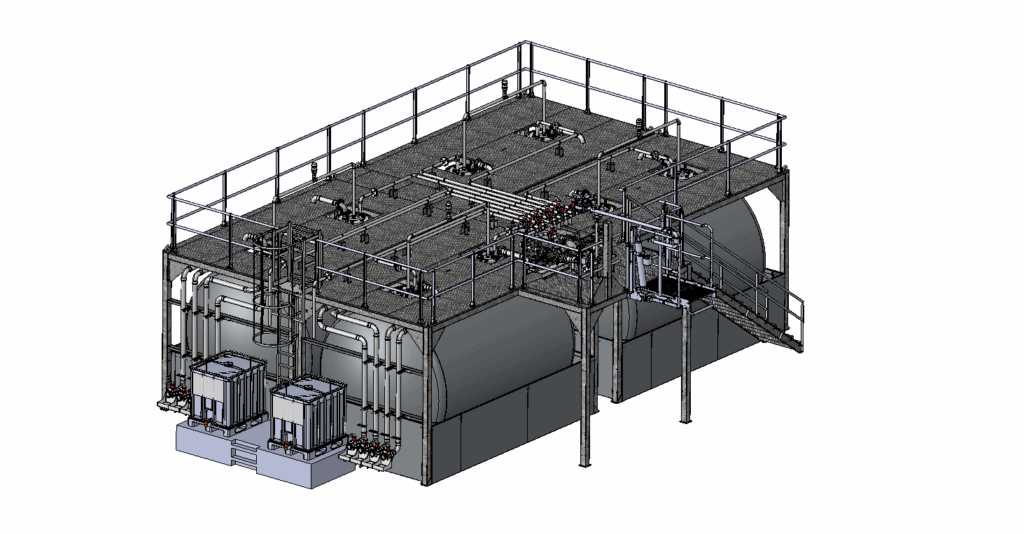
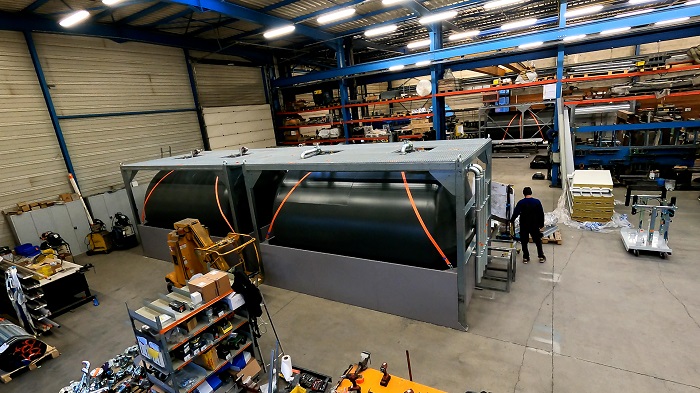
To meet these requirements, we designed an installation comprising four compartmentalized tanks, totaling eight compartments with a capacity of 15,000 liters each, as well as two spaces for 1,000-liter IBCs dedicated to storing specific references.
The tanks were installed on containment bunds to secure storage and protect the environment. The entire system was designed by our engineering office to optimize product flow, with an automated distribution system allowing the selection of the lubricant to be loaded into tanker trucks, along with an anti-mixing system ensuring product quality.
The equipment also includes a loading arm for trucks, a piping network dedicated to each product, as well as safety features such as stairs, guardrails, and access walkways to the loading dome.
The project began well before the construction phase with a 3D scan of the building, enabling precise modeling of the existing structure and integration of space and access constraints. This work was carried out in collaboration with IMPULS Ingénierie, an engineering office specialized in industrial structures.
We then analyzed the safety data sheets (SDS) of the products provided by Total to verify the chemical compatibility of the lubricants with the equipment (in coordination with equipment suppliers), adapt the piping and materials to each product, and design a safe and efficient distribution architecture.
Finally, a design and 3D modeling phase for the tanks, piping, and distribution circuits validated the layout and flow optimization.