As part of the European OLGA project (an EU-funded HORIZON 2020 project aimed at decarbonising airport activities), Lab Crigen, the ENGIE Group's research centre for green gases and energy transition, has launched an experiment in Romania aimed at fuelling a bus with BioGNV (renewable natural gas for vehicles).
This fuel is produced locally from biomethane using innovative technology to purify the biogas from a wastewater treatment plant that processes effluent from Cluj airport (Romania). To implement this project, Blocalps, a specialist in modular gas stations, was asked to design a tailor-made BioNGV storage and distribution solution adapted to a complex technical context.
The main technical constraint of this project was the low biomethane production rate of the scrubber, which required the addition of a buffer storage to optimise the station's operating cycles. This specific context made it impossible to refuel the vehicle directly without technical adaptation.
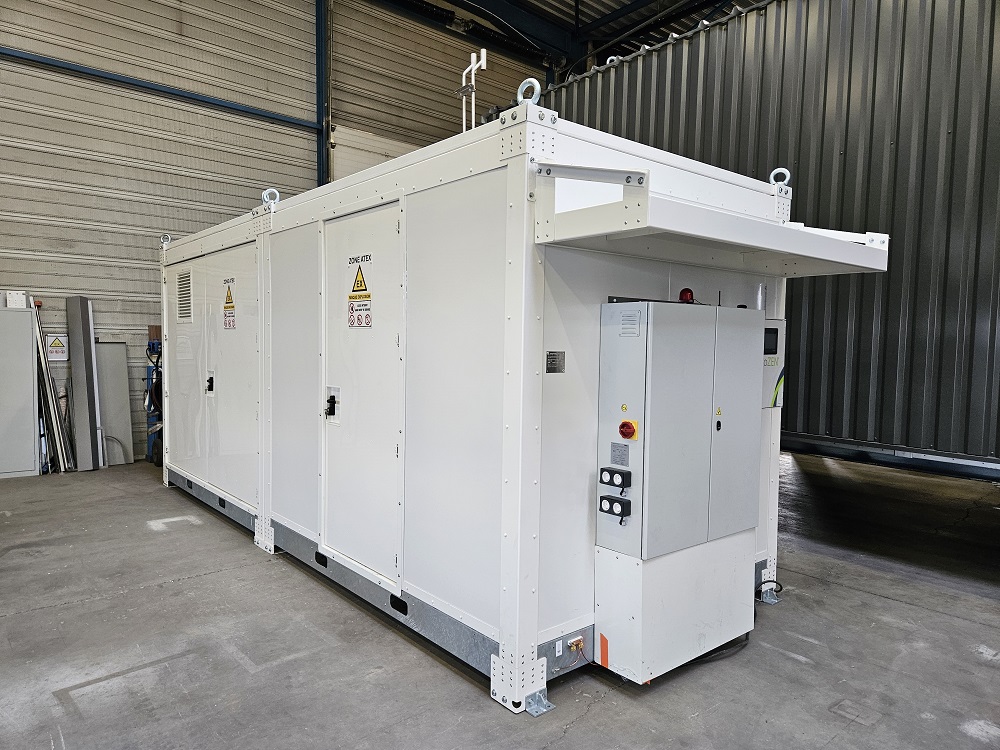
It was against this backdrop that ENGIE's Lab Crigen asked Blocalps to design, manufacture and test a containerised BioNGV station designed to operate with a raw biomethane source.
Thanks to its expertise in the integration of industrial processes in containers and in the manufacture of service stations for gaseous and liquid fuels, Blocalps has developed a modular system comprising two complementary units, based on the EVOBLOC model:
A 5,000-litre metal buffer tank, located upstream of the compressor, to optimise the operation of the compression system, ensuring a regular supply despite the low biomethane production rate.

Blocalps has incorporated several essential safety features into its solution:
This innovative project is enabling ENGIE's Crigen Lab, and more specifically the Biogas, Biomass & Waste Lab, to test in real conditions a new approach to sustainable mobility, adapted to environments with low volumes of renewable gas production.
Thanks to its expertise in the integration of industrial processes in containers and in the manufacture of service stations for gaseous and liquid fuels, Blocalps has developed a modular system comprising two complementary units,
The factory tests have been conclusive, and operational commissioning is scheduled for summer 2025.
With this project, Blocalps confirms its position as a key player in the development of BioNGV infrastructures in France and Europe, by offering robust, scalable and customised technical solutions